Bringing app generation into the Copilot ecosystem
Enhancing Copilot with a secure, generative app experience, while driving cross-organizational alignment across Microsoft.
Company
MicrosoftCopilot App Generation Native Capability
Role
Principal DesignerInterim Design Lead for a team of 4 designersCross-organizational experience strategy
Shipped
Sep 10, 2026Frontier release in Copilot
The internal end-to-end walkthrough I narrated for senior leadership ahead of the September Frontier release, for buy-in and alignment. Sound is off by default; turning it on starts my voiceover from the beginning.
Why app generation needed to move
In 2025, my team launched vibe.powerapps.com, a new standalone product to build enterprise apps with generative AI. By 2026, the opportunity had shifted. Instead of asking customers to visit a singular app-building destination, we could bring app generation to where they already worked.
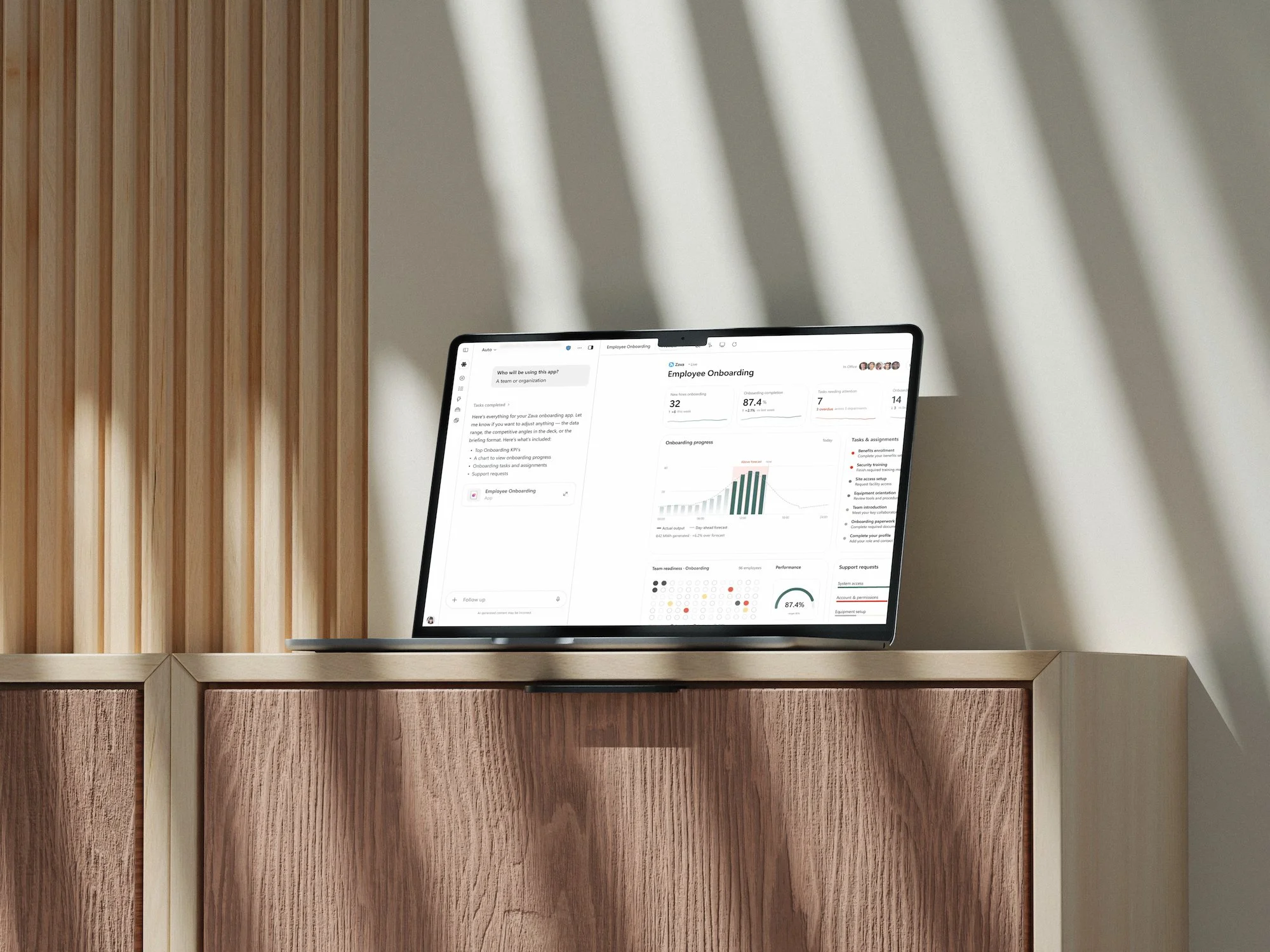
Microsoft Copilot Cowork (since merged into Copilot Home) was an agentic workspace where people delegate complex work and create many kinds of artifacts through natural language. Our goal was to build app generation as an intent-driven, native skill inside Copilot, seamless and cohesive with the rest of the end-to-end experience, rather than bolted on. People can describe what they need, get working software, refine it in conversation, then publish and share it with live data, identity and governance.
Evolution from product to platform
In September 2026, my previous manager had just left and my new manager was on leave. I stepped in as interim Design Lead, accountable for the shipment from concept and strategy through implementation. I led a team of 4 designers through a critical delivery window, working directly with Product, Engineering and the Copilot leadership team.
Right after our Frontier release shipped, a bigger problem came into focus. Multiple teams across Microsoft, including Managed Apps (publicly, Copilot Managed Runtime), Coral Pages, Edge and Fabric, were simultaneously building their own app-generation experiences. Focusing on solely making our experience was not enough, app generation had to feel like one consistent experience across all of these teams.
Many teams, many experiences, one customer
Fragmentation
Each team was solving a real customer problem, but with its own technology, interaction patterns and defining different scope for a generative app experience. Inside Copilot, those differences sat side by side. The same intent could produce different outputs, and headers, editing controls, navigation and publishing all varied.
Lightweight vs. enterprise-grade
Some experiences were built for fast exploration. Coral Pages, the team behind lightweight HTML page generation, made creation quick and explorative. Copilot Managed Runtime was built for durable business applications, with live data, identity, governance and organizational ownership. Customers need both, and need to understand the functional differences without feeling they've jumped between products. To a customer, an app is just an app; they shouldn't have to track our backend distinctions.
SharePublish
.html · Saved in OneDriveReact · Live data and backend calls
HTML page
Enterprise managed app
Built as
An HTML-based app
A React-based app
Primary action
Share is the primary action
Publish is the primary action
Data
Saved in OneDrive
Data manipulation and calls to the backend
Different clocks
Every team had its own release schedule, priorities and org commitments. We had to ship near-term improvements without losing the long-term direction.
Owning it without a safety net
My previous manager had just left, and my new manager was on leave. I was covering both roles at once, so decisions that would normally go up two or more levels were mine to make, mid-shipment, across dependencies I didn't control.
The challenge was to create consistency without sacrificing functionality, and to align multiple organizations without slowing any of them down.
Owning the delivery, aligning the ecosystem
Two scopes of leadership, one customer experience
Own the shipment end-to-end
As interim Design Lead, I drove design direction, experience quality and cross-functional alignment through the September release. As a Principal Designer rather than the team's manager, I led through influence more than authority. We brought app generation into Copilot as a new, native capability, making Copilot itself more comprehensive and enterprise grade. My role and responsibilities included rapidly onboarding the team onto a new design system language, new organizational communications and approval processes, while still driving clarity within our direct organization, delivering it all within two weeks. I resolved dependencies and made the calls needed to ship, while protecting what made Managed Apps different: the path from a compelling prototype to hosted, governed business software. The visual language was already set by Copilot's design system, so my craft here was in the decisions. I drove the cross-team decisions that smoothed the end-to-end experience. To make those calls concrete, I created a walkthrough video of the end-to-end flow for cross-team alignment and ultimately presented it to senior Copilot leadership for review, focusing on where and how people connect the data behind an app, and on the details of the overall information architecture and share experience.
Turn a shared worry into a v-team
Just before the Frontier release launched, I co-led the App Generation Coherence v-team, facilitating the broader Copilot strategy with a virtual team with designers from Cowork, Coral Pages, Managed Apps and a few other Microsoft teams. Our mission was a singular, coherent app-generation experience across Copilot, balancing consistent patterns with earned differences. The kickoff set the operating plan: an experience audit, defined scope, prioritized surfaces where fragmentation hurt customers most, shared design principles and launched a user research study to ground ourselves in data. We then formed working groups around the critical patterns:
Shared header and artifact controls
Secondary toolbars and inline editing
Workspace and canvas interactions
The relationship between .html pages and managed apps
Agree on principles before pixels
Four principles gave every team a shared language for evaluating designs:
Coherent, scalable, and flexibleCreate familiar patterns that work across different products and grow with customer needs.
Contextual by designSurface the right capabilities at the right moment without unnecessary complexity.
Transparency into the processHelp customers understand what AI is creating, changing, and managing.
Simple and encouragingMake sophisticated capabilities approachable without overwhelming users.
The principles made one distinction explicit: coherence doesn't mean identical. A difference stays when it serves a clear customer need.
Lead through influence, not authority
None of the teams reported to me. I convened cross-product working sessions, such as one on inline editing and toolbars, where I framed the problem, named the outcome and set a near-term goal of a joint proposal. I initiated a research study so our alignment decisions rested on hard data, not opinion.
Take it to leadership
Copilot Senior Leadership review · October 2026
In October, I was lead presenter to the Copilot Senior Leadership team, which included CVP and Partner-level directors across Design, Product and Engineering. The review tied our work to Copilot's broader product direction and asked for strategic guidance on how lightweight pages evolve into an enterprise-grade, managed app. Our team's pre-read and subsequent presentation, "From idea to business impact," framed that transition. It moved the conversation from individual UI patterns to a product strategy: one continuous journey from idea to trusted, governed business software.
The outcome: the senior leadership team agreed unanimously that growing an HTML page into a managed app should be seamless, with little to no product identifiers or UX getting in the way.
The coherence presentation I led for Copilot senior leadership, with Bobby and the other CVP and Partner-level directors: principles, the grow-up path from idea to business impact, and pattern guidance for headers and inline editing.
Delivering now, shaping what's next
Sep 10, 2026Frontier release in Copilot
Sep–Oct 2026Coherence work takes shape
Oct 2026Research-informed iteration
Oct 2026Leadership alignment
Nov 17, 2026General availability at Ignite
Sep 10, 2026
App generation ships in Copilot
Our app-generation skill launched natively in Copilot through the Frontier release, an early-access program for a select group of customers. App generation went from a separate product destination to a skill inside the place people already work. On launch day, we celebrated our 500th user of the day.
The first 11 days
500thUser of the day, on launch day
5,574Monthly active end users
42,316Monthly active end-user sessions
5,368Weekly active makers
3,199Weekly active apps
31,658Weekly app plays
Rolling 7-day thumbs-down rate21.5%down from 64.4%
21.5% now31.3% launch-period aggregate64.4% shortly after launch
Previous App Builder agent70
App generation in Copilot92
Internal app-gen eval score
Adoption was broad across makers and end users, and the thumbs-down rate fell steadily through the period. We read these as launch signals, not retention: 11 days of data is too early to call. The remaining work was clear, and it focused on the recurring complaints about preview, loading, errors and blank screens.
Sep–Oct 2026
The coherence work takes shape
The v-team completed its audit, aligned on principles, prioritized the highest-impact surfaces and launched focused working groups.
Oct 2026
Research-informed iteration
The study I initiated for the v-team tested our prioritized surfaces. In parallel, our lead researcher ran an end-to-end benchmark study with 10 experienced users, covering generation, editing, publishing, sharing and app management, and synthesized both sets of results together. One clear finding from the v-team study: critical UI needed written labels to be understood. Icons alone didn't land for makers on entry points like Edit or status cues like the Publish badge. The findings shaped the next wave of work on editing, progress feedback, discoverability and customer confidence.
Oct 2026
Leadership alignment
At the Copilot senior leadership review, we flagged the overlap between a lightweight HTML app and a managed app as a potential risk, before the Coral Pages team shipped to Entra Frontier preview. Raising it early put the issue on leadership's table before it reached customers, and the senior leadership team agreed unanimously that the grow-up path should be seamless. The review also connected near-term product decisions to the overarching Copilot product direction.
Nov 17, 2026
General availability
As of November 9, 2026, Copilot Managed Runtime apps had more than 100,000 monthly active users while still in preview. Copilot Managed Runtime went to General Availability at Ignite on November 17, 2026, alongside previews for local agent development with Microsoft Copilot Studio and Fabric app data, plus early access to Code Agents.
100,000+Monthly active users of Copilot Managed Runtime apps · Nov 9, 2026, still in preview
Scaling the system, not just the product
In 2025, I led a new team to turn an ambitious idea into a shipped product, 0-to-1. In 2026, I owned shipping that experience as a capability into a larger ecosystem, and led across organizations I had no authority over. Both stretched me in different directions: one through ownership, the other through influence.
Scaling a product takes more than scaling its features. It takes scaling the principles, systems and relationships that keep the experience coherent. Cross-organizational leadership works when you create shared understanding without needing central ownership: common principles, a short list of high-impact problems, and room for every team to contribute.
It also changed how I see AI-native design. As agents generate apps, workflows and other artifacts, the designer's job expands beyond individual interfaces. We shape how capabilities connect, how people understand what AI made, and how a quick page grows into software an organization can trust.
The biggest shift was moving from designing app-building interfaces to helping define patterns and principlesfor dynamic, agentic, intent-based experiences across Microsoft.