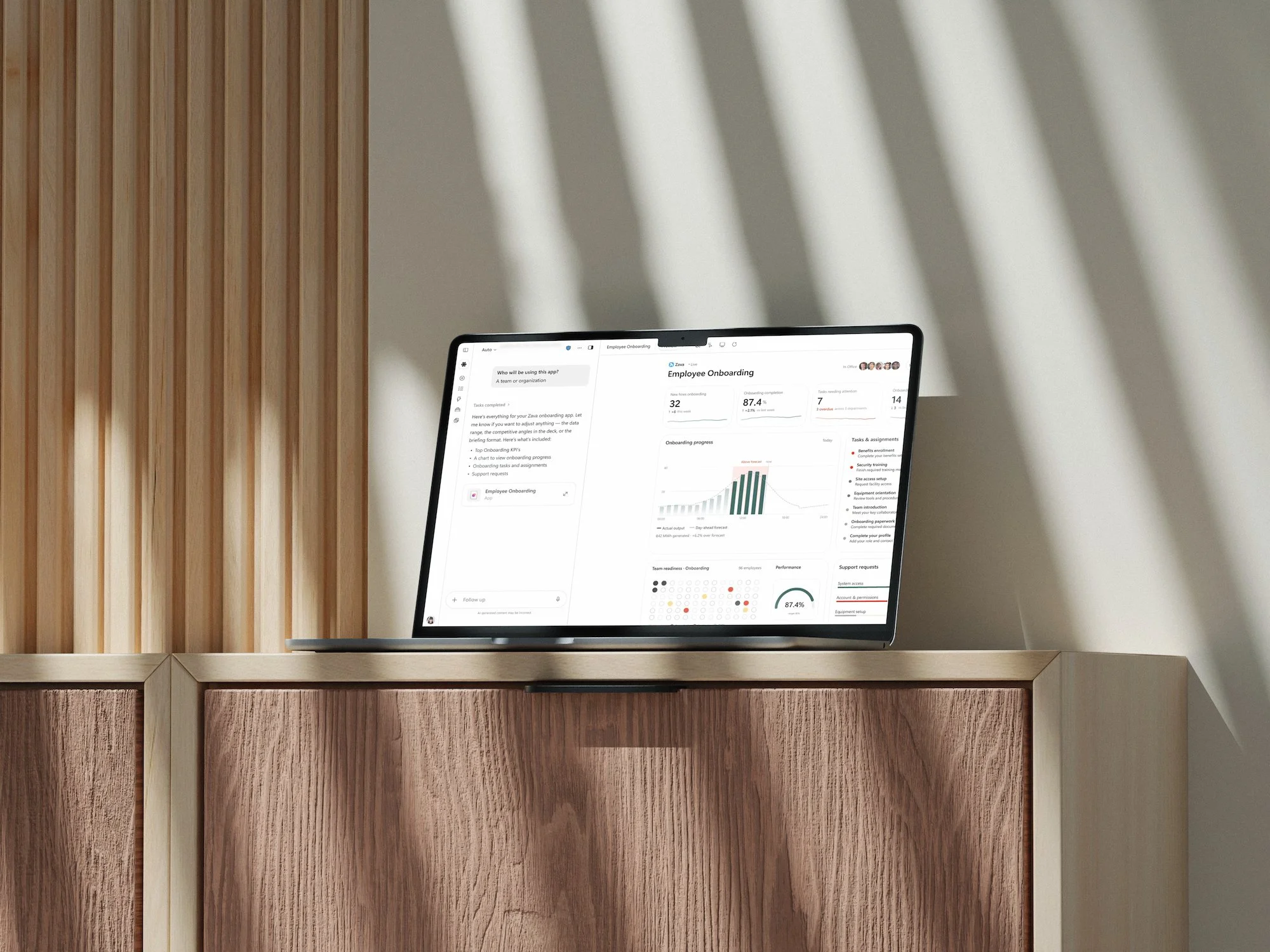
Bringing app generation into the Copilot ecosystem
Enhancing Copilot with a secure, generative app experience, while driving cross-organizational alignment across Microsoft.
Company
MicrosoftCopilot App Generation Native Capability
Role
Principal DesignerInterim Design Lead for a team of 4 designersCross-organizational experience strategy
Shipped
Sep 10, 2026Frontier release in Copilot
The internal end-to-end walkthrough I created for senior leadership ahead of the September Frontier release, for buy-in and alignment.
Why app generation needed to move
In 2025, my team launched vibe.powerapps.com, a new standalone product to build enterprise apps with generative AI. By 2026, the opportunity had shifted. Instead of asking customers to visit a singular app-building destination, we could bring app generation to where they already worked.
Microsoft Copilot Cowork (since merged into Copilot Home) was an agentic workspace where people delegate complex work and create many kinds of artifacts through natural language. Our goal was to build app generation as an intent-driven, native skill inside Copilot, seamless and cohesive with the rest of the end-to-end experience, rather than bolted on. People can describe what they need, get working software, refine it in conversation, then publish and share it on Microsoft's enterprise infrastructure.
Evolution from product to platform
In September 2026 I stepped in as interim Design Lead. I led a team of 4 designers from concept and strategy through implementation, partnering with Product, Engineering and the Copilot leadership team. Right after our Frontier release shipped, a larger problem came into view. Several Microsoft teams were simultaneously building their own app-generation experiences. Focusing on solely making our experience was not enough, app generation had to feel like one consistent experience across all of these teams.
Many teams, many experiences, one customer
Fragmentation
Each team was solving a real customer problem, but with its own technology, interaction patterns and defining different scope for a generative app experience. Inside Copilot, those differences sat side by side. The same intent could produce different outputs, and headers, editing controls, navigation and publishing all varied.
Lightweight vs. enterprise-grade
Some experiences were built for fast exploration. Copilot Managed Runtime was built for durable business applications, with live data, identity, governance and organizational ownership. Customers need both, and need to understand the functional differences without feeling they've jumped between products. To a customer, an app is just an app; they shouldn't have to track our backend distinctions.
A quick pageA governed business app
Different clocks
Every team had its own release schedule, priorities and org commitments. We had to ship near-term improvements without losing the long-term direction.
Owning it without a safety net
I stepped into a leadership gap mid-shipment, so decisions that would normally go up two or more levels were mine to make, across dependencies I didn't control.
The challenge was to create consistency without sacrificing functionality, and to align multiple organizations without slowing any of them down.
Owning the delivery, aligning the ecosystem
Two scopes of leadership, one customer experience
Own the shipment end-to-end
As a Principal Designer rather than the team's manager, I led through influence more than authority. We brought app generation into Copilot as a new, native capability, making Copilot itself more comprehensive and enterprise grade. My role and responsibilities included rapidly onboarding the team onto a new design system language, new organizational communications and approval processes, while still driving clarity within our direct organization, delivering it all within two weeks. I resolved dependencies and made the calls needed to ship, while protecting what made Copilot Managed Runtime different: the path from a compelling prototype to hosted, governed business software. The visual language was already set by Copilot's design system, so my craft here was in the decisions. I drove the cross-team decisions that smoothed the end-to-end experience. To make those calls concrete, I created a walkthrough video of the end-to-end flow for cross-team alignment and ultimately presented it to senior Copilot leadership for review, focusing on where and how people connect the data behind an app, and on the details of the overall information architecture and share experience.
Turn a shared worry into a v-team
I co-led the App Generation Coherence v-team, facilitating the broader Copilot strategy with a virtual team of designers across organizations with one objective: deliver a singular, coherent app-generation experience across Copilot, balancing consistent patterns with earned differences. Once the Frontier release shipped, it became a dedicated effort I co-led with a Copilot design lead. We started with an experience audit, defined scope, prioritized the surfaces where fragmentation hurt customers most, defined shared design principles and launched a user research study to ground ourselves in data. We then formed working groups around the critical patterns:
Shared header and artifact controls
Secondary toolbars and inline editing
Workspace and canvas interactions
The relationship between .html pages and managed apps
Agree on principles before pixels
Four principles gave every team a shared language for evaluating designs:
Coherent, scalable, and flexibleCreate familiar patterns that work across different products and grow with customer needs.
Contextual by designSurface the right capabilities at the right moment without unnecessary complexity.
Transparency into the processHelp customers understand what AI is creating, changing, and managing.
Simple and encouragingMake sophisticated capabilities approachable without overwhelming users.
The principles also made one distinction explicit: coherence doesn't mean identical. A difference stays when it serves a clear customer need.
Lead through influence, not authority
None of the teams reported to me. I convened cross-product working sessions, such as one on inline editing and toolbars, where I framed the problem, named the outcome and set a near-term goal of a joint proposal. I initiated a research study so our alignment decisions rested on hard data, not opinion. In October I presented the coherence work to the senior Copilot leadership team, moving the conversation from individual UI patterns to a product question: how lightweight AI-generated experiences should grow into enterprise-grade apps.
Our app-generation skill launched natively in Copilot through the Frontier release, an early-access program for a select group of customers. App generation went from a separate product destination to a skill inside the place people already work. Launch day brought a strong early milestone.
Higher app-generation quality than the previous app-building agent in internal evaluations
We read these as early launch signals, not retention. With less than two weeks of data, we kept investigating the experiences customers still flagged most.
The v-team completed its audit, aligned on principles, prioritized the highest-impact surfaces and launched focused working groups.
Oct 2026
Research-informed iteration
The study I initiated for the v-team tested our prioritized surfaces. In parallel, our lead researcher ran an end-to-end benchmark study with 10 experienced users, covering generation, editing, publishing, sharing and app management, and synthesized both sets of results together. One clear finding from the v-team study: critical UI needed written labels to be understood. Icons alone didn't land for makers on entry points like Edit or status cues like the Publish badge. The findings shaped the next wave of work on editing, progress feedback, discoverability and customer confidence.
Oct 2026
Leadership alignment
The coherence proposals reached the senior Copilot leadership team. In that review, we flagged a potential overlap to senior leadership before a partner team launched, raising the risk before it reached customers. Leadership agreed unanimously that the evolution of a lightweight page into a governed app should feel seamless, with little to no product labels or UX getting in the way. The work also connected near-term product decisions to a longer-term vision for unified app generation.
Nov 17, 2026
General availability
Copilot Managed Runtime apps kept growing through preview. Copilot Managed Runtime went to General Availability at Ignite on November 17, 2026, alongside previews for local agent development with Microsoft Copilot Studio and Fabric app data, plus early access to Code Agents.
In 2025, I led a new team to turn an ambitious idea into a shipped product, 0-to-1. In 2026, the challenge was to extend that capability into a larger ecosystem and influence experiences owned by other organizations.
Scaling a product takes more than scaling its features. It takes scaling the principles, systems and relationships that keep the experience coherent. Cross-organizational leadership works when you create shared understanding without needing central ownership: common principles, a short list of high-impact problems, and room for every team to contribute.
It also changed how I see AI-native design. As agents generate apps, workflows and other artifacts, the designer's job expands beyond individual interfaces. We shape how capabilities connect, how people understand what AI made, and how experiments grow into tools organizations trust.
The biggest shift was moving from designing app-building interfaces to helping define patterns and principlesfor dynamic, agentic, intent-based experiences across Microsoft.